

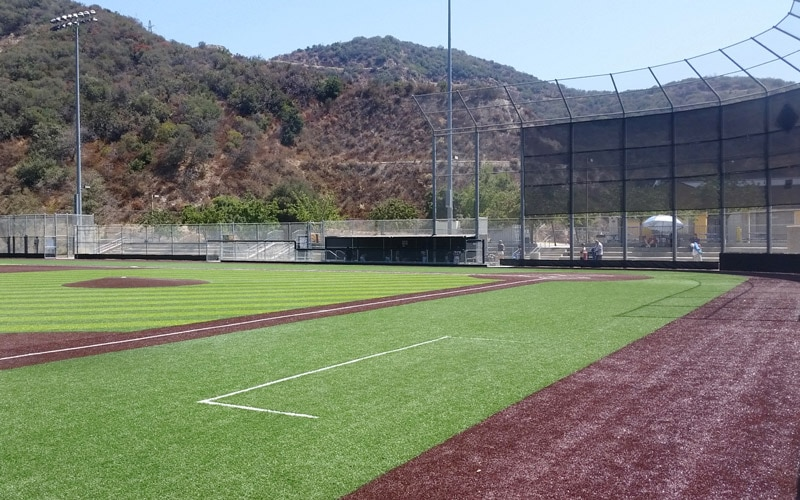
The Glendale Sports Complex, located at 2200 Fern Lane, is undergoing a major project initiated by the City of Glendale, specifically through Glendale Water and Power. The project seeks to establish an array of solar panels over part of the Complex’s parking lot, which could provide over two million kiloWatts of power and service roughly 301 homes annually. Furthermore, the project follows the success of two others in a solar initiative Glendale has named “Phase 1.” These were the Perkins Building in 2025 and the Central Library in March 2026.
The students of Clark Magnet High School, alongside the entirety of GUSD, are thought to see great change coming from this project. Many of Clark’s students are athletes who often use the complex for sporting activities, either with a club or independently. However, the resulting issues that the project has brought, such as the mass parking shortage, are seen to interrupt and inconvenience the students and many others who use the complex frequently.
One of the major contributors who played a big role in its preparation and plans is Dan Brotman, who is currently a member of the Glendale City Council. Brotman had a major role in the project’s creation and planning, as well as many other projects of the same type recently begun by Glendale.
“The energy from this project and others like it can bring power and electricity to homes and businesses for almost 20 years. It is expected that this project specifically will cost around $4.6 million in exchange for 1.3 megawatts of power,” Brotman said.
While a specific date has not been provided, Glendale Water and Power estimates the GSC project will be completed by June 2026 – next month. However, this does not include time for construction cleanup. It also does not include the time needed to establish electric charging stations in the section of the parking lot under the solar panel canopy. It is thought that the entire project will be completely finished by December 31.
Though the solar project will provide tons of energy for Glendale and its citizens, it comes at a cost. During the mass construction, the entire section of the parking lot being used for the project will be completely sealed off to the public. This action, while not fully blocking parking, will severely limit the number of spaces at the Glendale Sports Complex, causing a mass parking shortage. In fact, numerous individuals have had to resort to parking on the hill leading up to the complex, which the City of Glendale responded to by providing shuttle buses to transport people to and from the complex.
It is also thought that the project will provide LED lighting at night for its specific section of the parking lot and provide shade during the day. Moreover, the project’s inclusion of additional electric charging stations will provide much-needed convenience for electric cars. The current charging stations are at the parking lot’s opposite corner. The new charging stations that are part of the solar project will be right at the entrance.
Overall, it is hoped that the project at the Glendale Sports Complex will bring massive success and benefits to the overall well-being of Glendale and its community, in exchange for a temporary parking shortage and inconvenience. The bottom line is that the project is expected to contribute greatly to Glendale society in terms of energy and power.